
AI agents for biostatistics
and trial design
Trial design and simulation, statistical programming from SAP to TFL, and digital twin simulation. Purpose-built agents that run in your environment and your toolchain — with an audit trail, source citations, and traceable logic on every output.
The constraint isn't producing the analysis. It's proving it on a deadline that doesn't move.
The design decides the cost of the trial, and the methods that would optimize it are the ones there is never time for: real-world evidence to ground control-arm assumptions, Bayesian and adaptive designs, simulation across the assumption grid, digital twins to test a design before anyone is enrolled.
SAP development, SDTM-to-ADaM programming, and TFL generation consume weeks per trial against a lock date that does not move. Double programming absorbs much of what is left, and every deliverable has to arrive with its derivations documented and defensible.
The same statisticians carry both, so design iteration becomes unbudgeted work competing with the study that owes an analysis. Headcount is not the lever — a senior biostatistician is a scarce hire, and the req takes months to fill even when it is approved.
Trial design and simulation
Estimands formalized per ICH guidance, then sample size and power mapped across the assumptions that drive the design. You get the feasible design region, not a single recommended n — a statistician handed one number cannot negotiate with clinical.
- Input
- Indication, endpoint, comparator, published evidence base
- Run
- Power and sample size across effect size, dropout, and interim rules
- Output
- The feasible design region, each assumption cited
Runs on published evidence, so it needs nothing from your environment to start.
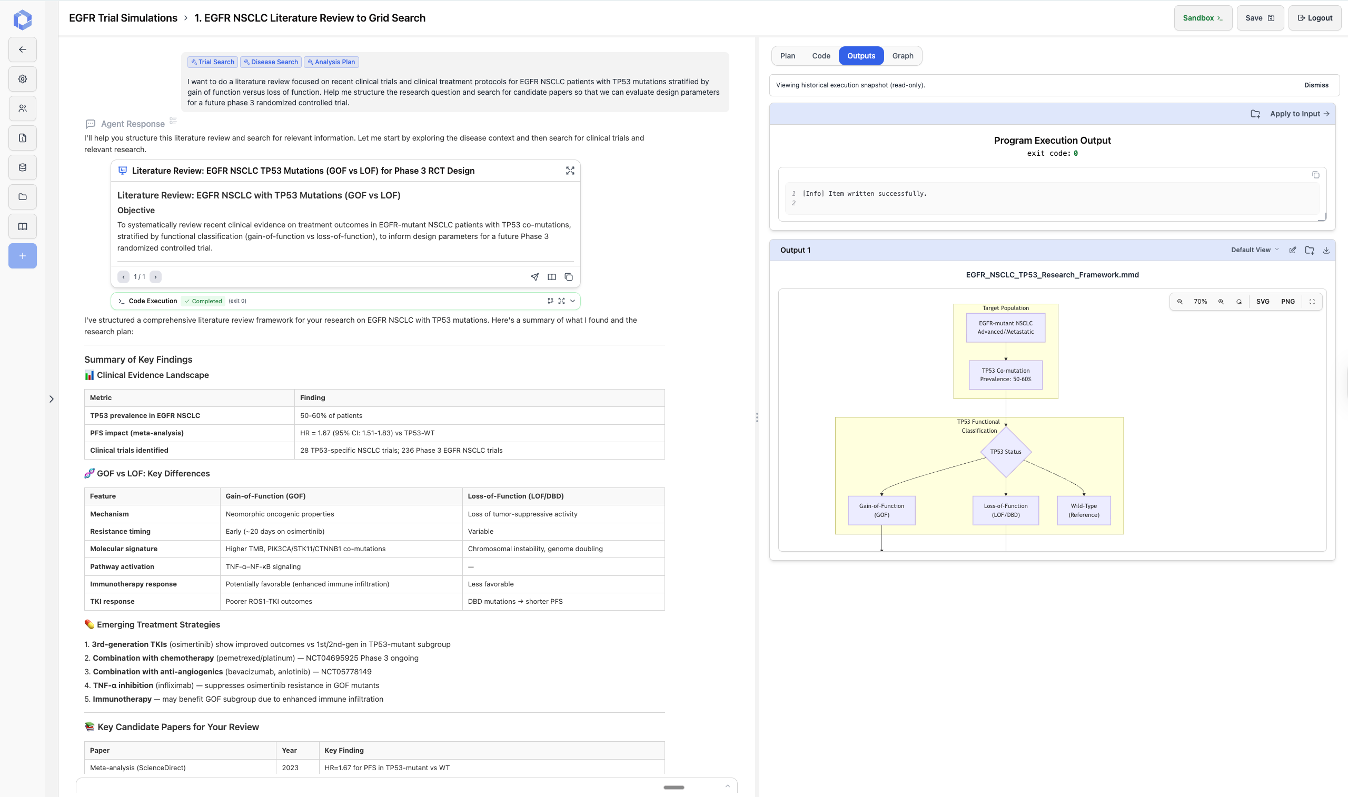
Literature review resolved into a research framework — the evidence landscape and candidate papers behind every assumption the design will rest on.
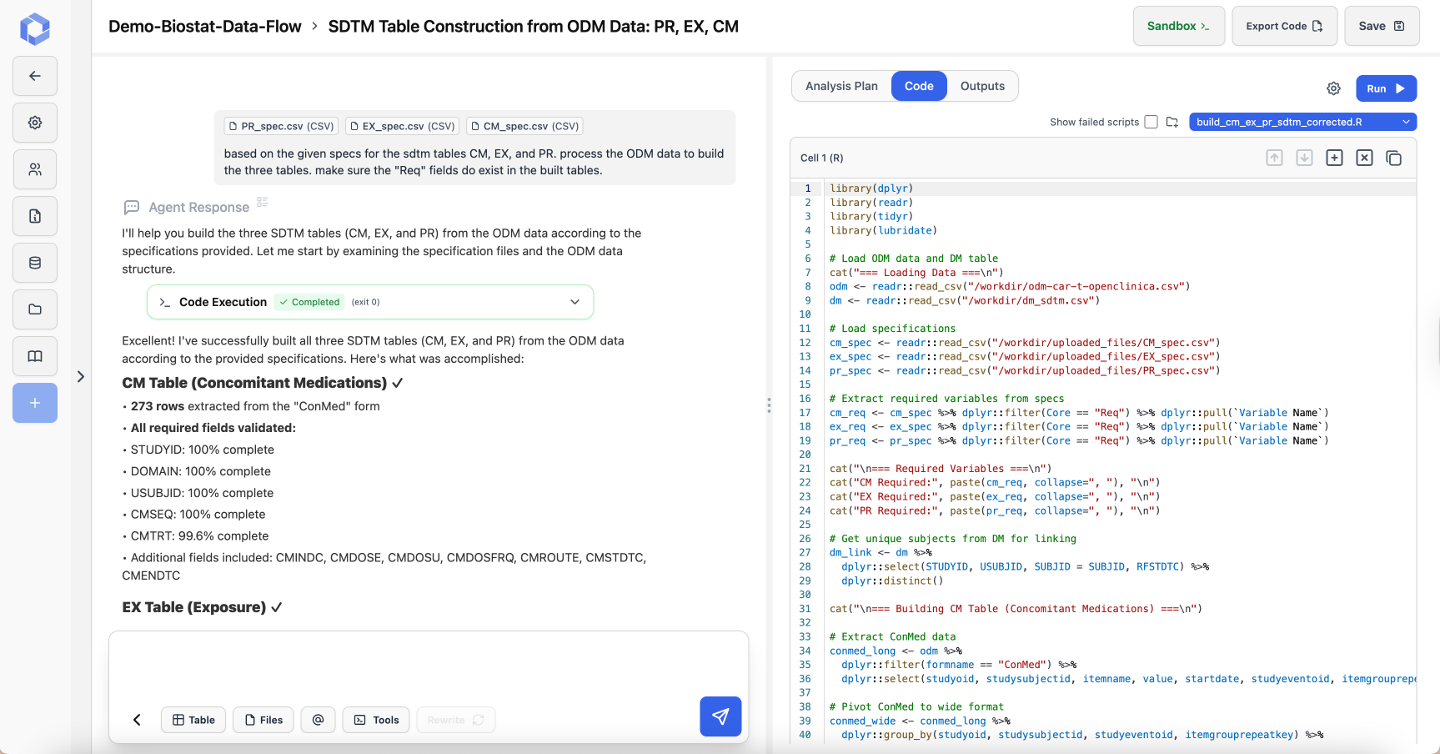
PR, EX, and CM built from the uploaded specs, with the generated R visible and exportable.
Statistical programming, SAP → TFL
Validated SAS and R generated from your actual SAP, following your macro standards, with define.xml, the reviewer's guide, and an audit trail running from source record to final table. Not a black box that returns datasets — five reviewable steps, each inspected before the next one runs.
- 01SDTM construction from raw ODM
- 02Domain mapping at scale, with checks built in
- 03ADSL derivation traceable to SDTM
- 04Rule-based ADaM validation, reported rule by rule
- 05TFL generation, define.xml, reviewer's guide
This is the workflow where the gain is countable — in programmer-weeks, against a lock date already on your calendar.
Digital twin and patient-level simulation
Two capabilities that compound. Patient-level datasets rebuilt from results and survival curves reported in the literature, so a design can be simulated against realistic patient trajectories before you have enrolled anyone — and without access to anybody's raw data. Then prognostic models on your own completed studies, stratifying patients by predicted outcome and quantifying the sample size a design would actually support.
Reconstruction gets you a defensible comparator where none existed; prognostic adjustment converts it into a smaller trial that retains its power.
If this changes, what else is impacted?
An amendment is where traceability pays for itself. Today, realigning SAP amendment → spec → dataset → TFL takes the whole team months, and most of that time goes to working out what was affected rather than to changing it.
Because every deliverable is linked to the derivation and source behind it, TrialMind monitors that chain continuously — within a study and across a programme — and lists the affected code, specs, datasets, and tables before the work starts, not during QC.
Checkable rather than asserted
AI control plane separate from the secure data plane. No raw data leaves your environment. SOC 2 Type I and II audited, ISO 27001 certified, HIPAA compliant.
Agents trained on clinical trial data rather than a general model prompted at it, with published benchmarks on clinical tasks.
Indexed across 14 registries and medical ontologies — not retrieval over the open web.
Bring your own R, Python, and SAS code, templates, and skills. Call TrialMind from scripts. Save, share, and re-run pipelines.
A multi-step analysis workflow that takes roughly three months by hand, completed in about a day — with a human setting the target and reviewing the results.
DSWizard, Nature Biomedical Engineering 2026. All publications
Pick one workflow and we will run it
Use a completed or public study, redacted or synthetic data, or your own materials under NDA and inside your environment. In 30 minutes we will show you what TrialMind found — and how it got there.
We reconstruct patient-level data from the published trials in your space, run the design grid on it, and walk you through what it shows.
We build the prognostic model and show what sample size that design would have supported, against the number you enrolled. You already know the answer — you are checking our work.